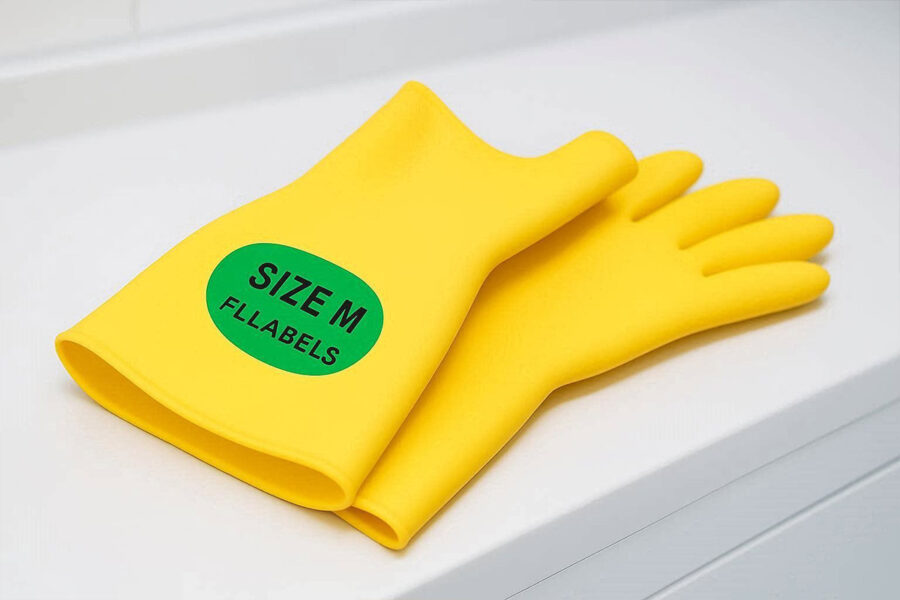
If you produce medical or industrial rubber or nitrile gloves and struggle with fading or peeling labels, this guide shows how specialized glove labels deliver permanent identification through sterilization and chemical exposure.
For medical, industrial, and laboratory glove manufacturers, permanent, legible labeling is non-negotiable. Your customers need to instantly identify glove type, size, material, and certifications—even after repeated sterilization, chemical exposure, or washing.
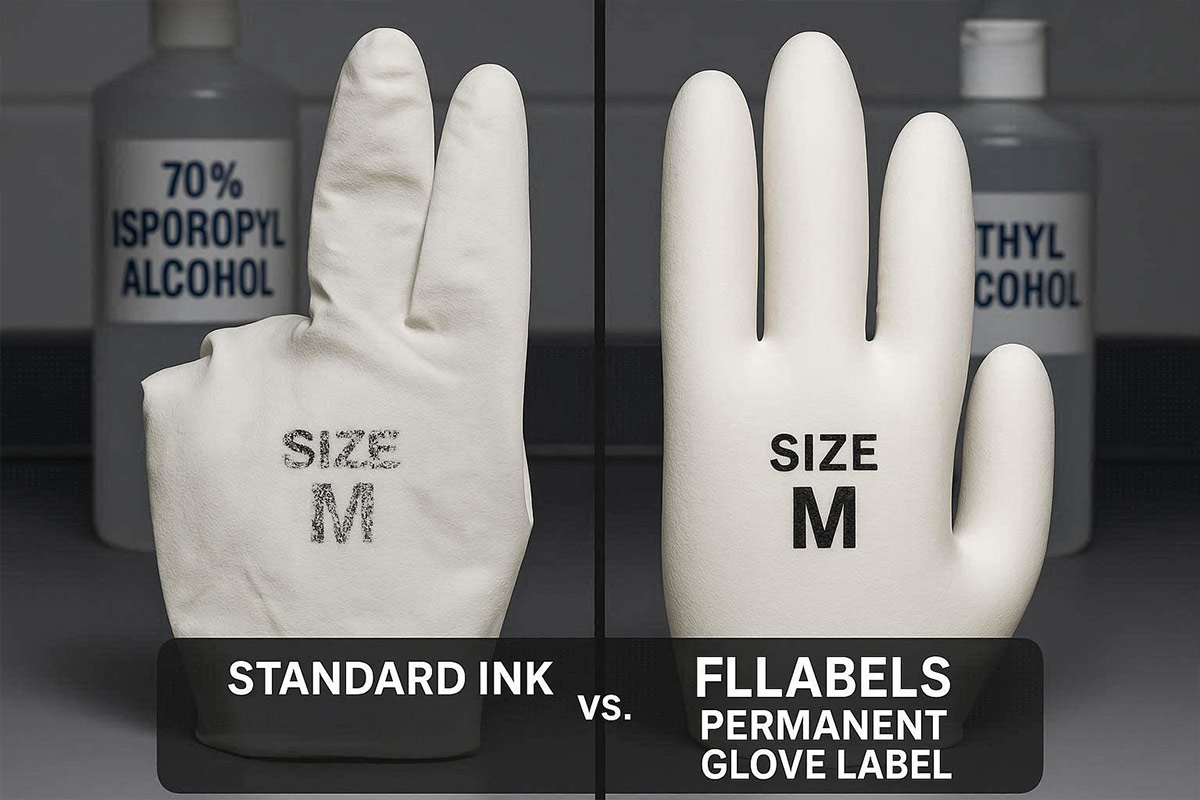
Yet traditional methods like ink stamps, surface stickers, or laser marking often fail: ink smudges, labels peel, and critical information disappears.
The solution? Specialized glove labels engineered for rubber and nitrile substrates—available in two proven formats:
- Vulcanizable labels for dipped rubber gloves (latex, nitrile) during production
- High-adhesion transfer labels for finished gloves that can’t undergo curing
In this guide, you’ll learn:
- Which labeling method fits your glove manufacturing process
- What data you can print (size, CE, FDA, QR codes, etc.)
- How to meet global compliance standards
- Real results from glove OEMs worldwide
- How to get free samples for testing
The Challenge: Labels That Survive Real-World Use
Gloves face extreme conditions:
- Medical gloves: Autoclaving (121°C), alcohol wipes, repeated donning
- Industrial gloves: Oil, solvents, abrasion, UV exposure
- Chemical gloves: Acid/alkali contact, high-pressure washing
Standard surface printing fails within days. Missing or unreadable labels lead to:
- Safety risks (wrong glove for the task)
- Regulatory audits failing (missing CE/FDA marks)
- Brand reputation damage
- Increased customer support calls
Two Proven Solutions from FLLabels
1. Vulcanizable Labels (For Dipped Rubber Gloves)
Ideal for manufacturers of latex, nitrile, or neoprene gloves produced via the dipping process. The label is applied to the glove form before leaching and curing. During vulcanization, it bonds permanently with the glove wall.
Advantages:
- Becomes part of the glove—no surface layer to peel
- Survives autoclaving, gamma radiation, and chemical exposure
- Supports full-color logos and multi-language text
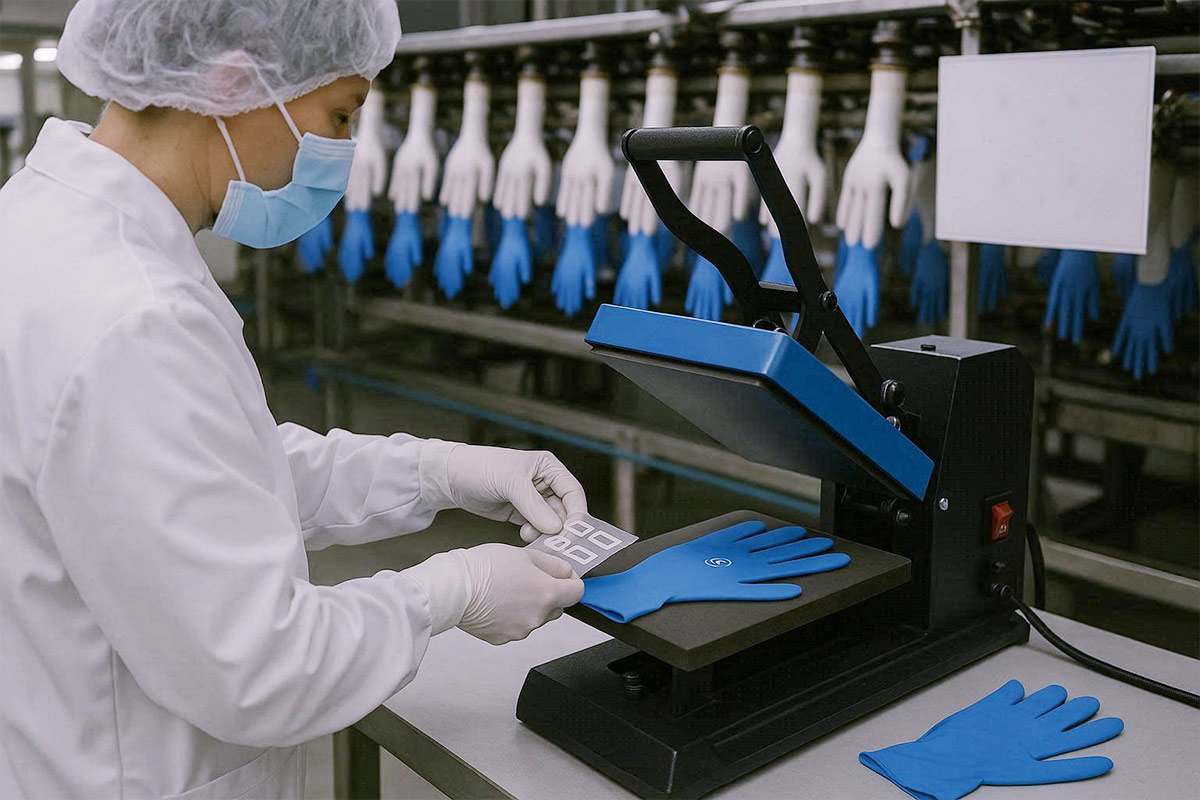
2. Heat-Activated Transfer Labels (For Finished Gloves)
For gloves that are not vulcanized post-dipping (e.g., most nitrile exam gloves), we offer high-adhesion transfer labels. Applied via heat press (120–140°C for 10–15 sec), they bond strongly to the surface without damaging the glove.
Advantages:
- No change to your production line
- Works on pre-packaged gloves
- Resists alcohol, detergents, and light abrasion
What Can You Print on Glove Labels?
Our digital printing supports:
- Brand name & logo
- Glove type: Nitrile, Latex, Neoprene, Vinyl
- Size: S / M / L / XL
- Powder-free / Textured / Exam Grade
- Certifications: CE, FDA 510(k), ISO 13485, ASTM D3578/D6319
- Batch number & expiry date
- QR code linking to SDS or product page
- Multi-language: English, Spanish, Arabic, Chinese
Compliance & Safety Standards
All our inks and substrates are:
- Heavy-metal-free (compliant with EU REACH)
- Biocompatible (tested per ISO 10993 for skin contact)
- Non-cytotoxic (safe for medical use)
- Resistant to EN 374 chemicals (for industrial gloves)
Technical Specifications
| Parameter | Vulcanizable Labels | Transfer Labels |
|---|---|---|
| Best For | Dipped rubber gloves (with curing) | Finished gloves (no curing) |
| Application Temp | 150–180°C (during cure) | 120–140°C (heat press) |
| Ink Durability | Permanent, embedded | Surface bond, alcohol-resistant |
| Certifications | ISO 10993, REACH, ISO 13485 | Same |
| Lead Time | 7–10 days (custom) | 5–7 days |
Real Client Impact: Case from a Medical Glove OEM
A Southeast Asian medical glove exporter switched from inkjet to FLLabels’ transfer labels for their nitrile exam gloves. Results:
- ✅ Passed FDA audit with clear, permanent CE/FDA marks
- ✅ Reduced customer complaints by 35%
- ✅ Enabled QR-based product authentication to combat counterfeits
“The label stays readable even after 6 months in hospital storage,” said their QA manager.
Frequently Asked Questions (FAQ)
Are your labels safe for skin contact?
Yes. All materials are ISO 10993 certified for biocompatibility and free from cytotoxic substances.
Can you print on textured or chlorinated gloves?
Yes. Our transfer labels adhere well to textured, chlorinated, and polymer-coated surfaces. We’ll test with your specific glove type.
Do you support small batch orders?
Absolutely. MOQ starts at 5,000 pieces for custom designs. Free samples available.
How do I apply transfer labels?
Use a standard heat press at 130°C for 12 seconds. We provide a detailed application guide with your sample kit.
Why Global Glove Makers Trust FLLabels
- 20+ years in rubber labeling
- ISO 9001 & ISO 13485 compliant production
- Imported, medical-grade inks and substrates
- Global shipping with export documentation
- Free technical support and sample testing
Get Your Custom Glove Label Solution
Don’t risk failed audits or customer complaints. Test our glove labels in your own environment—free of charge.
Includes: Vulcanizable + transfer options + compliance guide + application instructions.